Karya terbaik dalam jurnal internasional bereputasi menghadirkan terobosan metodologis dalam analisis yang memperoleh rekognisi internasional melalui proses peer-review yang ketat.

Foreign languages in higher education are increasingly diverse, one of which is Japanese language learning. This is so that language learners have enough capital to compete in a multilingual global world. Language learning is a process where learners perform a language activity in accordance with the language rules they learn. These differences in linguistic rules need to be considered by language teachers and learners. Based on the differences in these rules, in this study, the foreign language learners referred to are learners whose first language (L1) is a local language, and Indonesian as the language learning (LL). The focus of this research is the difference in Japanese structure and rules. This is related to the use of the dative marker ni, verb conjugation in the process of the Japanese passive structure, translation, and the meaning of the Japanese passive sentence that appears. The research method used is descriptive qualitative method. The results of this study show that (1) the construction that forms the Japanese passive verb is ~rareru/~reru, (2) if the actor that appears in the passive structure is animate, then the marker used is ni, (3) if the actor that appears in the passive structure is inanimate, then the marker used is ~ni yotte, (4) Another uniqueness of the Japanese passive is if Japanese passive structures that use intransitive verbs, the translation into Indonesian becomes unacceptable. So it will become acceptable in translation, if the Japanese passive structure is changed to the Japanese active structure.
Published : 2025-05-20
Category : Bereputasi

Usada Bali is a traditional Balinese healing practice that uses natural materials like plants for medicine. This practice is recorded in Balinese script on lontar leaves. Modern technology and synthetic medicine have reduced the use of some traditional medicinal plants and caused a language shift from Balinese to Indonesian, even for traditional medicine terminology. Now, these materials are often written in Indonesian to describe their usage. This study aims to analyze the language strategies regarding the Usada Bali lexicon applied by the student's parents at elementary school at Denpasar and Klungkung Regency. It examines students' proficiency in traditional medicine types, treatment techniques, and related medical problems, and factors influencing their understanding. Using qualitative methods and surveys, the study found that most parents (66.3% in Denpasar and 83.3% in Klungkung) use Strategy 7-a language strategy involving Balinese Language with their children, the same as that employed in the neighborhood domain. As a result, 59.2%-81.9% of students understand the traditional medicine lexicons. The study concludes that besides Strategy 7, other factors such as family demographics and the presence of multiple generations play significant roles in maintaining the Balinese language and Usada Bali lexicons, as part of oral traditions and Balinese Culture, which are crucial for preserving Balinese cultural identity.
Published : 2024-10-12
Category : Bereputasi

Following the issue of Bali's Governor Regulation no. 80/2018, which oblique all public signs in Bali to put Balinese script transliteration above all Latin Scripts, the Balinese language is starting to gain its identity in Bali's public spaces, especially in Kuta Village. However, its transliteration process encounters many problems, from law violation accusations to irregularities and errors. This research aims to formulate a dedicated software or application to process a standard transliteration of Latin to Balinese script. The data were collected throughout all the main roads in Kuta village to assess and evaluate transliteration errors in public spaces. These errors are included in the designed set of data-based and reformulated standard rules of public space Balinese transliteration. The data showed errors in Balinese transliteration on some public signs in Kuta, such as errors in script choice, script pattern system, and pronunciation adaptation. These errors are further analysed to reformulate the standard form of transliteration by adapting the standard rule in the created application system. Finally, an application of transliteration is designed to address all the errors of the Balinese transliteration. The application is called Nyastra: Nyurat Aksara Transliterasi [writing script transliteration]. This application's design is registered in Indonesian Intellectual Copyright no. EC00202379260 on September 9th, 2023.
Published : 2024-07-12
Category : Bereputasi

Public space is one of the most accessible areas to the public eye. Placing any sign in a public space within a given territory creates a linguistic landscape environment. One of the essential functions of a linguistic landscape is representing a certain given territory’s symbolic meaning. This symbolic meaning may represent local ideology or identity and local/national authority’s power. This phenomenon occurs in Kuta village, Badung Regency, Bali Province, Indonesia. Due to a lack of local identity, all public sign in Bali is oblique to put Balinese scripts transliteration above all Latin scripts as mandated by Bali’s Governor Regulation no. 80/2018. This authority’s power of language use over public space is one of Bali’s government’s efforts to gain its local identity in public space through public signs. This study aims to further analyse the transliteration of Latin script to Balinese script in public signs in Kuta village, as previous research indicates some mistakes and irregularity. This analysis is needed to identify, refine and regulate the transliteration procedure since Balinese script is a syllabic system different from Latin script. The finding showed that some issues must be maintained and regulated to have a good transliteration of Balinese script in public space as a landmark of Balinese identity in Bali’s public spaces.
Published : 2023-09-19
Category : Bereputasi

Batukau temple, a remote Hindu temple on the slope of Mount Batukau, unavoidably undergoes the extending function of the Hindu temple from purely a spiritual site to a spiritual and tourist destination. This additional status as a tourist destination consequently changes the face of the outdoor sign’s language in the temple. This study investigates the current language contestation of the outdoor signs in the temple compared to its original status as a spiritual sanctuary. The data were documented through the direct observation method with photographic techniques. At the same time, the comparative data of the previous condition were collected from various public online sources. The result shows that Balinese script presentation is less salient than the roman script. It is treated as a symbolic function to emphasise Bali’s identity in the area. The presence of the Indonesian and English languages is highly dependent on their message and location. They play their roles in non-spiritual related outdoor signs, such as informational signs on environmental, education, sanitation issues and prohibition signs related to the temple’s status as a sacred place. Furthermore, all languages are used in Covid-19 prevention signs.
Published : 2022-06-21
Category : Bereputasi

Covid-19 is a global pandemic that changed people perspective in everyday life, either in personal activities or public activities. Covid-19 had caused an economic crisis all over the world, including in Indonesia. In order to support business and commerce sustainability in this pandemic situation, the government, through the Health Department, had issued a circular letter No. HK.02.01/MENKES/335/2020 about Covid-19 prevention in the commercial sector known as New Normal protocol. The tourism industry is one of the most devastated by Covid-19. The tourism industry must adapt to this new normal life by implementing the new standard protocol in running its business. This study aimed to analyse the meaning of the new normal protocol signs at Rabasta @Kuta Hotel in Kuta. The result showed many new normal signs found in every public or strategic area of the hotel. The placement of the signs highly influences the visualisation of the signs. For instance, there is a sign next to a washbasin at the hotel’s front gate with a clear statement that directed all guests to wash their hands before entering the hotel area. Another sign is placed in a public area showed a neutral standard operational procedure notice of Covid-19 prevention. In terms of composition meaning, those signs showed an ideal and real value of new normal practices. The salience is about personal and environmental hygiene to stop the spread of Covid-19 with either linear or nonlinear framing to the extent of the desired meaning.
Published : 2021-08-25
Category : Bereputasi
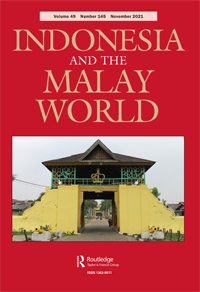
Kuta in Bali, is an over developed urban city, observed through the emergence of outdoor signs along the main streets. However, there were no local laws to regulate the use of local language in public spaces, which led to the marginalisation of the Balinese language. In 2018, Bali’s Governor Regulation no. 80/2018 was issued to regulate the use of languages in Bali, exclusively to maintain local language in public spaces. This study is aimed at investigating the effect of the regulation on the use of local language in Kuta’s public spaces. The data were collected from six main streets in Kuta in January 2020. The result showed that the Balinese language had gained a prestigious position in public space with its addition on many outdoor signages. Conversely, this regulation is alleged to violate national law that obliges all public signs be in the Indonesian language and placed above local and or foreign languages on the same sign board.
Published : 2021-04-19
Category : Bereputasi

This is a case study of linguistic landscapes (LL) with multimodal approach, which aimed at analysing the visual grammar of commercial outdoor sign. LL is a study of signs in public space. These signs include all traffic signs, billboards, site names, and advertisements. Multimodal approach is a new concept of analysis that analyses signs from three aspects, and it is representation, interaction and composition. The data in this study is classified as a secondary data that randomly chosen from author previous research. There were three outdoor billboard signs chosen to represent all proposed LL types in Kuta Village. The results showed that representations of actors in outdoor signs are all salience. Their representations are not merely as an icon of human but also a figure, a symbol, or a voice index as replacement of callout statement. In terms of interaction processes, all actors act as the salience of demand and/or offering information, service and product with objective attitudes. For composition processes, the salience are all centred with various information value position and yet they are non-linear text framing. All text stand independently with the same ideal and real information as the producers intended to be.
Published : 2020-04-13
Category : Bereputasi

Balinese oral tradition is very strong and unique due to its complexity and sacred. The most obvious known Balinese oral tradition is mantra, kidung and kakawin. These traditions are only mastered by those who committed to learn them seriously, because all written sources of those traditions were originally written in Balinese Scripts known as anacaraka. This study is aimed to investigating the presence of Balinese Scripts in public spaces in Kuta village as part of tradition and globalization. In this globalization era, tourism industry development has changed the environment face of Kuta into multilingual spaces. But, unfortunately, it was found that Balinese Scripts only use in traditional spaces in which it was marginalized by others. In 2018, in order to preserve the local tradition and identity, Balinese Government issued a regulation that oblique all outdoor signs in public spaces should put Balinese Scripts transcription above their Latin words. The research finding showed significance proves that through the power of authority, Balinese language and Scripts have begun to gain their position in public spaces, not just represented as a traditional sign but also as a local identity in international market shares. Almost all commercial signs of 4-star and 5-star hotel and restaurant along the main streets used Balinese Scripts transcription above their Latin names. These indicate that Balinese tradition has survived from globalization in Kuta.
Published : 2020-04-10
Category : Bereputasi
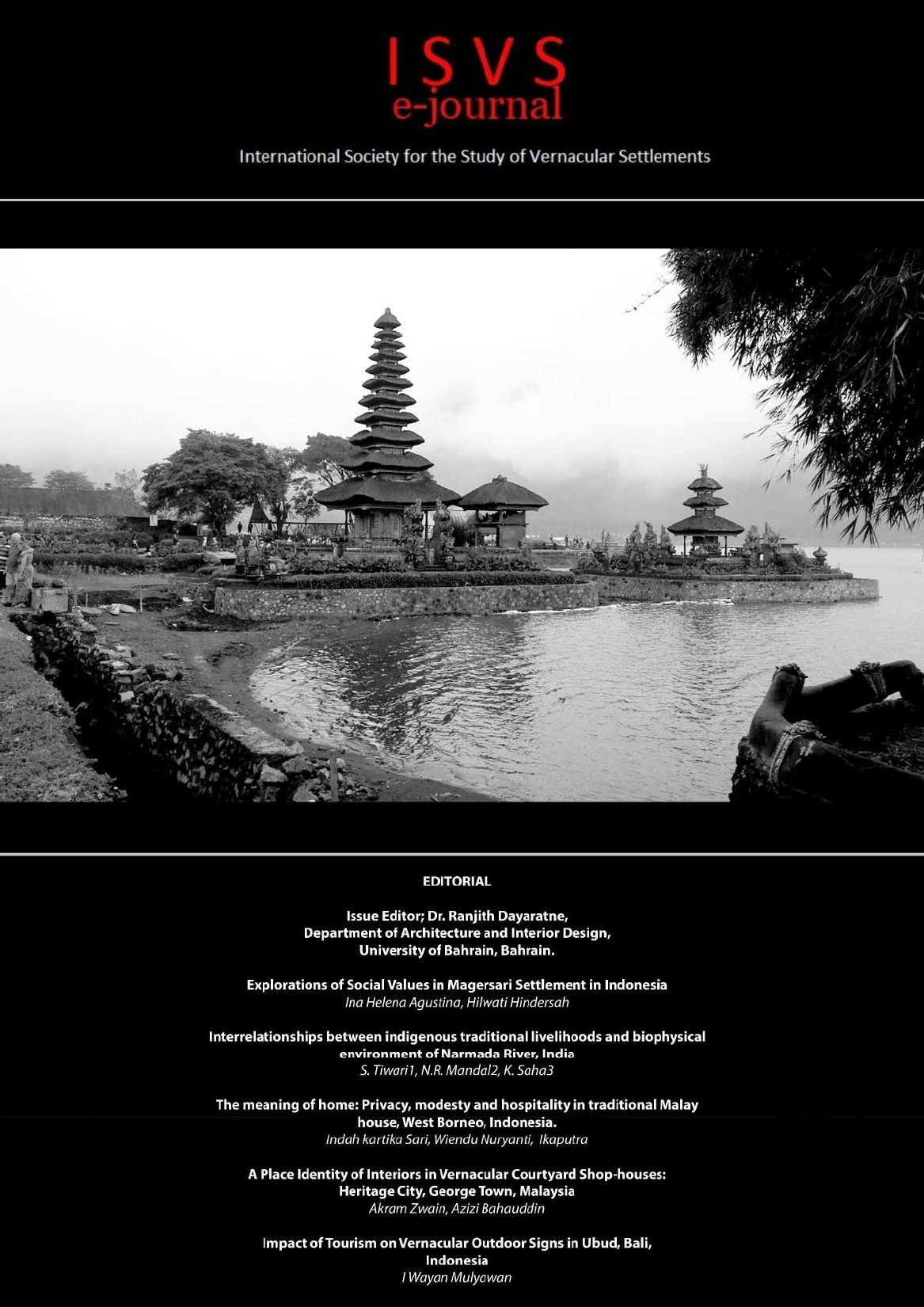
This study investigates the impact of tourism on Ubud vernacular outdoor signs in term of their language used and designs. Ubud as one of the tourist destinations in Bali experiences changes in development of outdoor signs. The language use and the design of outdoor signs is the reflection of the vernacular. The research was conducted from April to May 2018. The data was collected through documentation method along Jalan Raya Ubud as the research location. There were 757 data of outdoors signs found in the area. The finding showed that there are 11 types of outdoor signs in Ubud. There were 201 signs of mini market/shop/phone shop was found and the least outdoor signs was signs of legal office with only 3 signs. In terms of the language, 458signs (60,50%) of the total signs use English, followed by 144 signs (19,02%) in Indonesian and only 9 signs (1,19%) in Balinese. This showed a decline in the use of vernacular language in outdoor signs in Ubud Bali as an effect of tourism. Besides, the visual design of vernacular architecture of the outdoor signs also showed strong asymmetry in which only 3 signs (0,4%) use vernacular language with vernacular architecture design and 699 signs (92,32%) used modern architecture with either Balinese, Indonesian or English.
Published : 2019-01-10
Category : Bereputasi